
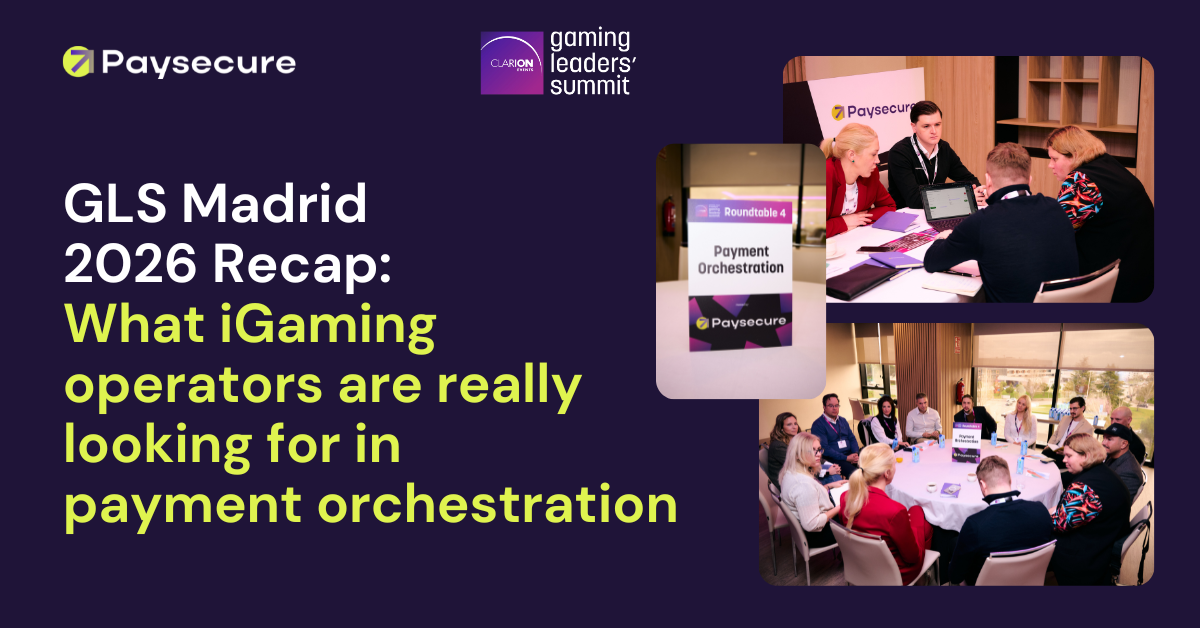
At this year’s Gaming Leaders Summit in Madrid, Paysecure hosted a roundtable discussion with a group of operators exploring one of the most important infrastructure questions in iGaming today; how to build a payment ecosystem that can support global growth while maintaining strong approval rates and player experience.
Few sectors put more pressure on payments than iGaming. Operators process high transaction volumes across multiple jurisdictions, payment methods and regulatory frameworks. Approval rates, latency, issuer behaviour and local payment preferences all directly impact player acquisition, retention and revenue.
Against that backdrop, payment orchestration is increasingly being viewed not just as a technical integration layer, but as a strategic tool for optimising payment performance.
The discussion brought together operators at different stages of their orchestration journey, but a number of clear themes emerged.
Payment orchestration as a revenue optimisation layer
One of the strongest points raised during the discussion was the growing recognition that orchestration can have a direct impact on revenue. By intelligently routing transactions across multiple PSPs and acquirers, operators can adapt payment flows based on geography, issuer behaviour and real-time performance signals. Instead of relying on a static payment setup, orchestration allows operators to continuously optimise where transactions are processed.
For high-volume industries like iGaming, even small improvements in approval rates can have a significant financial impact. Depending on the configuration, operators at Gaming Leaders Summit reported approval uplifts ranging from around 0.5% to as high as 20% when routing strategies are actively optimised.
Solutions such as intelligent payment routing, powered by advanced AI technology, allow merchants to dynamically select the most effective provider for each transaction, by continuously analysing real-time data, historical performance, and transaction-level variables. This enables AI-driven routing to identify the optimal path for every payment, helping to maximise acceptance rates, reduce unnecessary declines, improve cost efficiency, and maintain greater operational control across multiple providers.
Reducing dependency on a single PSP
Another theme that resonated strongly across the group was the move away from relying on a single payment service provider. Many operators are adopting a multi-provider payment strategy, distributing traffic across several PSPs to reduce risk, improve resilience and create stronger negotiating positions with providers.
However, managing multiple PSP integrations can quickly become operationally complex. This is where orchestration platforms provide great value, acting as the central layer that manages integrations, routing logic and payment performance across providers.
By consolidating payment management into one platform, operators gain flexibility without increasing operational overhead. Orchestration solutions, such as Paysecure’s platform, not only provide access to a growing ecosystem of providers, but a wealth of centralised intelligence to fuel routing in real-time. This delivers greater resilience and redundancy through features such as cascading, as well as clear visibility into performance per provider. With these rich insights, operators can design payment flows that adapt dynamically bringing in new providers to support market expansion, redundancy or to aid cost management.
One integration unlocking multiple markets
Connectivity and scalability were also recurring themes throughout the discussion. Launching in new markets often requires new acquiring relationships, local payment methods and additional integrations. For operators expanding internationally, managing these integrations individually can slow growth and place significant strain on development teams.
With a single API integration to an orchestration platform, operators can connect to multiple PSPs and acquirers through one environment. This dramatically reduces integration complexity and enables faster expansion into new markets.
For companies operating across regulated jurisdictions, this level of connectivity can significantly accelerate market entry while maintaining a consistent payment infrastructure. Paysecure combines powerful technology with rapid deployment, enabling integrations in as little as two weeks and reducing time-to-market by up to 80%.
Advanced optimisation tools are becoming essential
Operators also highlighted the increasing expectations placed on orchestration platforms themselves. Beyond basic routing, merchants are looking for deeper optimisation capabilities that allow them to actively manage payment performance. This includes AI-driven routing algorithms, traffic segmentation tools and configurable routing logic, reflecting a shift to payments 3.0, moving beyond automation to heightened intelligence that fuels dynamic payment journeys and real-time optimised workflows.
The ability to segment traffic using parameters such as user-defined fields (UDFs) was also discussed as a valuable optimisation tool. By segmenting traffic based on market, brand, licence or player type, operators can apply more sophisticated routing strategies tailored to different transaction profiles.
In high-volume payment environments, this level of control allows operators to fine-tune payment performance in ways that were previously difficult to achieve.
The cashier is becoming a strategic conversion touchpoint
The discussion also moved beyond infrastructure and into the player experience. Increasingly, operators see the cashier not simply as a payment interface but as an important part of the player journey. The way payment options are presented, the steps involved in completing a transaction and the overall user experience can all influence conversion rates.
Modern cashier solutions, such as the Paysecure dynamic Cashier, allow operators to customise the payment interface and gather behavioural insights into how players interact with the payment journey. Understanding where users hesitate, abandon transactions or encounter friction provides valuable insights that can help optimise the deposit experience.
When combined with orchestration and routing optimisation, cashier design becomes another lever for improving payment performance, with Paysecure delivering measurable impact across key metrics. This includes up to 7% increase in acceptance rates through AI-driven routing, recovery of up to 10% of previously failed transactions via automated acquirer switching, and up to 35% higher deposit values driven by hyper-personalised cashier experiences. Combined with rapid integration timelines of as little as two weeks, these capabilities enable operators to optimise performance while maintaining agility and resilience in a fast-moving digital environment.
Real-time reporting and operational visibility
In a high-transaction environment such as iGaming, real-time insight into payment performance is essential. Operators highlighted the need for live reporting and monitoring tools that allow them to track approval rates, provider performance and transaction flows as they happen. This visibility becomes particularly important during major sporting events or peak traffic periods, when payment volumes surge.
Access to real-time dashboards allows payment teams to respond quickly to performance changes, adjust routing strategies and maintain high acceptance rates during critical revenue windows, with Paysecure’s AI-driven technology automatically actioning these insights in real time to optimise routing decisions and sustain performance without manual intervention.
Flexible rollout strategies reduce implementation risk
A common misconception discussed during the Gaming Leaders’ Summit roundtable is that orchestration must be deployed across all payment traffic at once. In reality, many operators prefer a phased rollout approach, starting with a specific market, licence or payment flow before gradually expanding orchestration across their wider infrastructure.
This approach allows payment teams to test routing strategies, measure performance improvements and optimise configurations before scaling across their entire operation. For fast-growing operators, this incremental approach provides both flexibility and confidence when introducing orchestration technology.
High value in fragmented and emerging payment markets
Finally, the conversation turned to where orchestration tends to deliver the greatest impact. Regions such as Africa and Latin America were frequently mentioned as markets where orchestration provides significant value. These regions often have fragmented payment ecosystems with multiple providers, local payment methods and varying issuer behaviour.
Orchestration empowers operators to navigate this complexity more effectively by connecting multiple providers and dynamically routing transactions to the most effective processing partner. Operators expanding card processing capabilities also see strong benefits, as orchestration helps optimise authorisation rates across different issuers and acquiring relationships.
Payments are becoming a competitive advantage
If one conclusion emerged clearly from the discussion, it is that payments are no longer simply a back-end function in iGaming. As operators scale internationally and competition intensifies, payment performance, player experience and infrastructure flexibility are becoming strategic differentiators.
Payment orchestration sits at the centre of this shift, enabling operators to optimise approvals, expand into new markets more efficiently and deliver smoother payment experiences for players.
At Paysecure, we’re seeing growing demand from operators looking to take greater control of their payment performance through orchestration, intelligent routing and configurable cashier experiences.
The conversation in Madrid reinforced what we’re hearing across the industry: in high-volume sectors like iGaming, the way payments are managed can directly influence growth, conversion and long-term profitability.
If we didn’t connect at GLS, we’d welcome the opportunity to continue the conversation, so please get in touch with the team today.